
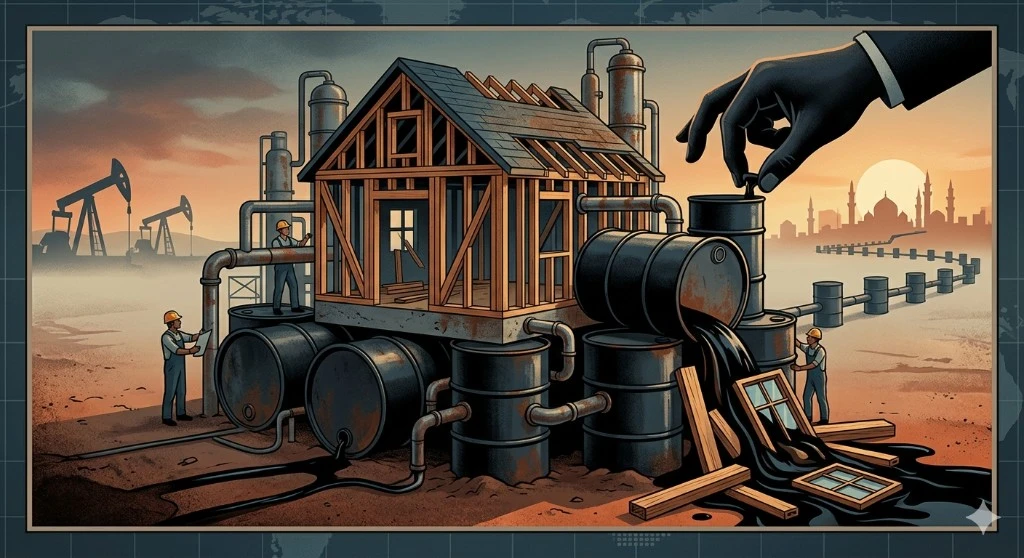
The modern home is not just wood and nails. In reality, it is a sophisticated collection of refined petroleum products.
As we navigate the current instability in the Middle East and the resulting disruptions in the Strait of Hormuz, we are not just looking at higher gas prices for our trucks today. We are facing a systemic surge in the cost of raw materials and logistical operations that will inevitably drive increased margin compression down the line. This lag is the real danger. These costs will hit our books at a time when homebuilder demand is already weak and our ability to pass on price increases to customers is severely limited.
The Hidden Oil in Your Build
Most builders watch the price of gas for their trucks and call it a day. But the reality is that oil is baked into almost every invoice you pay. Even when you think you are buying "natural" materials, you are usually buying a refined petroleum product in disguise.
Lessons from 2008: The "Commuter Collapse"
We have seen this movie before. In 2008, when oil hit $145 per barrel, the mathematical calculus of suburban living collapsed. Long-haul commuter towns saw a spike in defaults because gas prices became a second mortgage payment.
The 2026 Warning: Do not get stranded with inventory in outlying submarkets if rising transportation costs make them untenable for your buyers. High energy prices can fundamentally shift where people want to live.
4 Strategic Moves for the "Fractional CFO" Mindset
To survive this volatility, you have to move from retrospective bookkeeping to prospective financial leadership.
- Pivot to "Spec-First" Sales
In an inflationary market, pre-selling your entire backlog is a massive risk. By the time you pull permits, your margins have evaporated.
- Lock in Neighborhood-Level Bidding
Stop bidding house-by-house. Leverage your total volume to lock in pricing for an entire community or phase of development.
- The Bilateral Escalation Clause
The traditional fixed-price contract is a liability in a volatile market. To protect your spread, you need to shift the conversation from a set price to a managed price. Implementing a mutual or bilateral escalation clause allows for price adjustments if costs spike by more than 3% based on objective data.
To build trust, you are not asking for a blank check. You are tying any price adjustment to third-party benchmarks that the client can verify.
It is important to remember that you do not have to trigger an escalation clause just because the math allows it. It is there if you need it. Most builders prefer to honor their original prices, which is often the right business move for your reputation. However, in the aftermath of COVID, we saw that many builders needed these clauses just to stay in the black.
We call it a bilateral adjustment to make the contract easier to sell. It shows the client you are being fair by offering to drop the price if costs go down. But let's face it: prices are not going to go down. The downward part of that clause is mostly for optics. The upward part is what saves your business.
- Don't Just Cut VPOs: Update Your Takeoffs
The VPO (Variation Purchase Order) is the bane of a clean P&L. In a market where prices are shifting every week, you have to be careful that you are not just fixing these costs with a quick VPO without addressing the root cause.
When a vendor notifies you of a price increase, the instinct is to just cut a VPO and keep the job moving. But if you do that without updating your takeoffs, you are just slapping a Band-Aid on a sucking chest wound.
The Fix: Every time a price change comes in from a vendor, you must go back and update your master takeoff. This ensures every future house in that community is budgeted correctly from day one. It stops the margin bleed before it starts.
The Bottom Line
The instability in the Middle East is a direct hit to your bottom line, but it is a hit that shows up on a delay. You cannot change the price of oil, but you can control how much of that volatility hits your P&L.
The goal for the next 12 months is to move as much risk as possible off your books and onto a managed system. Whether you are using CBUSA for national buying power, ruthlessly updating your takeoffs, or finally putting a bilateral escalation clause into your contracts, you need a plan for the lag. If you are not tracking these shifting costs in real-time and adjusting your pricing to match, you are leaving your margin up to chance.