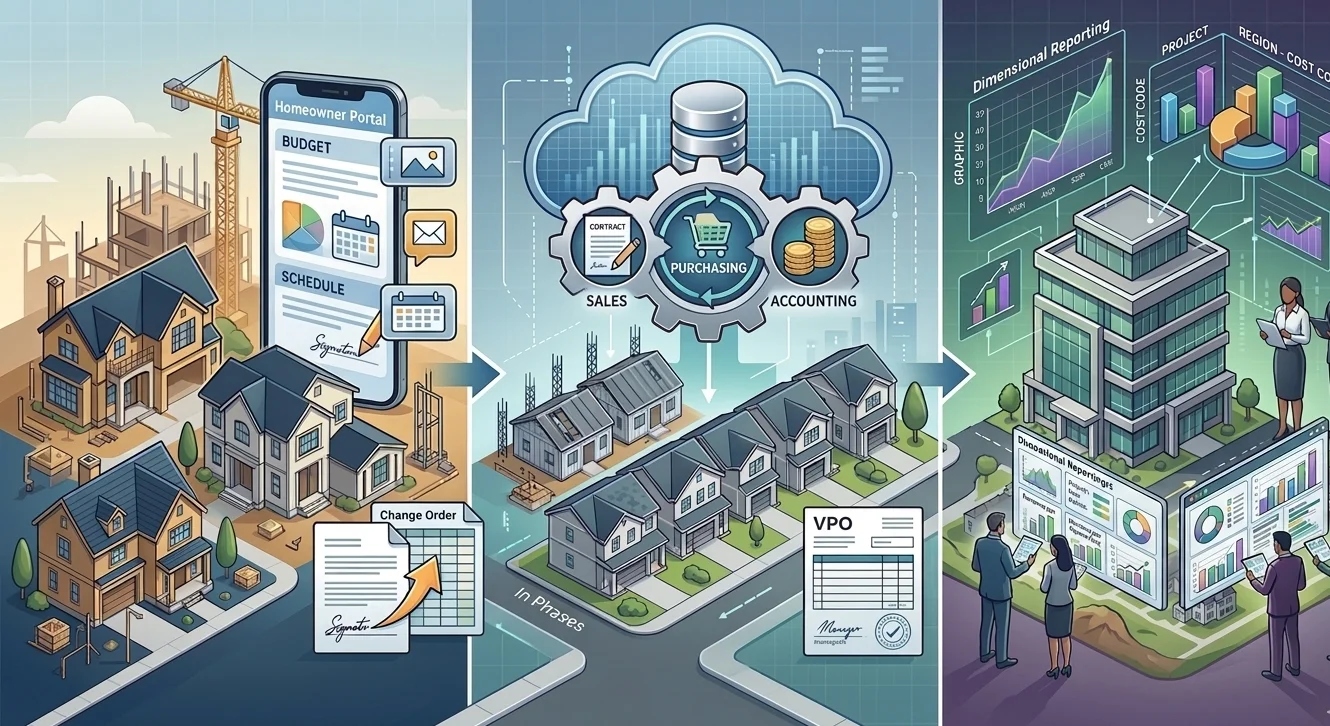
Choosing the right homebuilder management software and homebuilder accounting software matters. In the residential construction industry, software is more than an administrative utility; it is a strategic determinant of project margins. As you scale from custom starts to hundreds of production units, the ideal platform changes. The following is an analysis of how the industry's leading solutions compare.
Buildertrend + QuickBooks: The Custom Experience Leader
Best for: Custom Builders and Remodelers producing 1 to 50 units annually.
In the custom world, you are managing a homeowner's emotional journey as much as a physical structure. Buildertrend is designed to make that journey transparent and professional.
•Strength: Client Transparency. The platform's hallmark is its robust homeowner portal. Clients can view real-time budget and schedule updates, see progress photos, access daily logs, and message the builder directly. This proactive sharing reduces client anxiety and minimizes time spent on repetitive check-in calls.
•Strength: Change Order Control. Buildertrend excels at capturing scope creep. Digital signatures and real-time budget approvals within the portal ensure every selection change is documented and reflected in the financial forecast before work begins.
•Weakness: Disconnected Accounting Operations. The fundamental flaw in this stack is a workflow that requires you to manage construction accounting in Buildertrend and sync that data into QuickBooks. This forces your team to run operations across two different software packages. Because job-costing data lives in the project management tool rather than the accounting system, you lose the ability to leverage modern AP automation or robust financial integrations. This results in a manual, fragmented workflow that lacks the construction-first depth required to scale beyond a boutique level.
ECI MarkSystems (IHMS): The Fully Integrated ERP
Best for: Production and Semi-Custom Builders producing 50 to 250 units annually.
As you move into production, the priority shifts from the client to the process. MarkSystems, also known as IHMS, is a single-database Enterprise Resource Planning (ERP) system where sales, purchasing, and accounting live in a unified environment.
•Strength: Total Organizational Alignment. Because the solution is fully integrated, your team does not need to toggle between multiple platforms. A sales agent uses the same software as the purchasing and accounting teams, just within a different module. This makes it easier for team members to understand where data originates and lives, which reduces the learning curve for how different departments impact one another.
•Strength: Zero-Sync Integrity. In a single-database model, there is no syncing required. When a sales agent selects a design option, a purchase order is instantly available for the back office and the construction schedule is updated for the superintendent.
•Strength: Purchasing Discipline. The system enforces a fixed-price culture. It automates purchase orders based on specific house configurations. If a superintendent needs extra materials, they must justify the expense through a Variance Purchase Order (VPO), which alerts management to margin erosion before the vendor is paid.
•Weakness: Native Reporting vs. Unified Data. The out-of-the-box financial reporting in IHMS can feel basic. However, because it is a unified database, it is significantly easier to build custom operational reports and dashboards that pull data from every corner of the business.
•Weakness: The Configuration Trap. While IHMS is intuitive when set up correctly, many builders struggle because their systems are poorly configured or underutilized. Builders often fail to understand individual features within each module, leading to a messy database that can take years to rectify. The software is rarely the problem; rather, it is a lack of organizational discipline during the setup phase.
Sage Intacct + Hyphen Homefront: The Enterprise Intelligence Stack
Best for: Regional Powerhouses and Multi-Entity Organizations producing 250 to 500+ units annually.
Large-scale builders require financial intelligence, which is the ability to analyze data across multiple legal entities and regions without relying on complex spreadsheets.
•Strength: Homefront Operational Front-End. While Sage Intacct manages the back office, Hyphen Homefront serves as the operational muscle. It manages the lead-to-contract lifecycle using rules-based options to eliminate selection mistakes. On the purchasing side, Homefront generates purchase orders from assembly-based estimates and pushes them automatically into Sage Intacct for payment. This ensures data flows into the finance department without manual re-entry.
•Strength: Dimensional Reporting. Unlike traditional systems with a linear Chart of Accounts, Sage Intacct uses dimensions. You can tag transactions by project, region, or cost code, allowing you to drill down into the performance of a specific floor plan across the entire organization with a few clicks.
•Strength: Statistical Accounts. This is the only stack that effectively stores non-financial data, such as square footage or headcounts, alongside financial figures. This allows you to automate critical KPIs, such as revenue per square foot, directly in your dashboards.
•Weakness: The Budget-Locked Workflow. A major operational challenge in Sage Intacct is the handling of cost codes. Unlike other systems where all cost codes are available for all projects, Intacct requires cost codes to be manually loaded onto individual projects via the budget. If you need to post an unbudgeted cost later, you must update the project's budget structure before the transaction can occur. This rigid workflow can create administrative friction if estimating is not perfectly precise.
•Weakness: Implementation Depth and Talent Requirements. This is an audit-ready enterprise solution that requires significant investment. Setup is a major front-end challenge that takes longer to configure than builder-grade applications. Managing the dimensional architecture and strict project-loading requirements generally requires professional-grade financial talent.
The Verdict: How Do You Scale?
•Choose Buildertrend if your priority is homeowner satisfaction and you need an intuitive tool to manage custom variability.
•Choose MarkSystems if you are a production builder who needs to eliminate data silos and stop profit leaks through rigid variance control.
•Choose Sage Intacct + Homefront if you are managing a complex regional empire and need deep dimensional visibility and best-in-class automation.
At HomebuildingCFO, we don't just advise on these systems; we have implemented them on the ground for multiple builders. We specialize in system integration planning, custom reporting, and system audits to help you leverage the powerful features you may not be using currently. From accrual accounting to custom Power BI reporting, we ensure your chosen platform becomes a true profit engine.
Ready to stop fighting your software and start using your data? contact us today for a systems strategy session.
Contact Us Today