
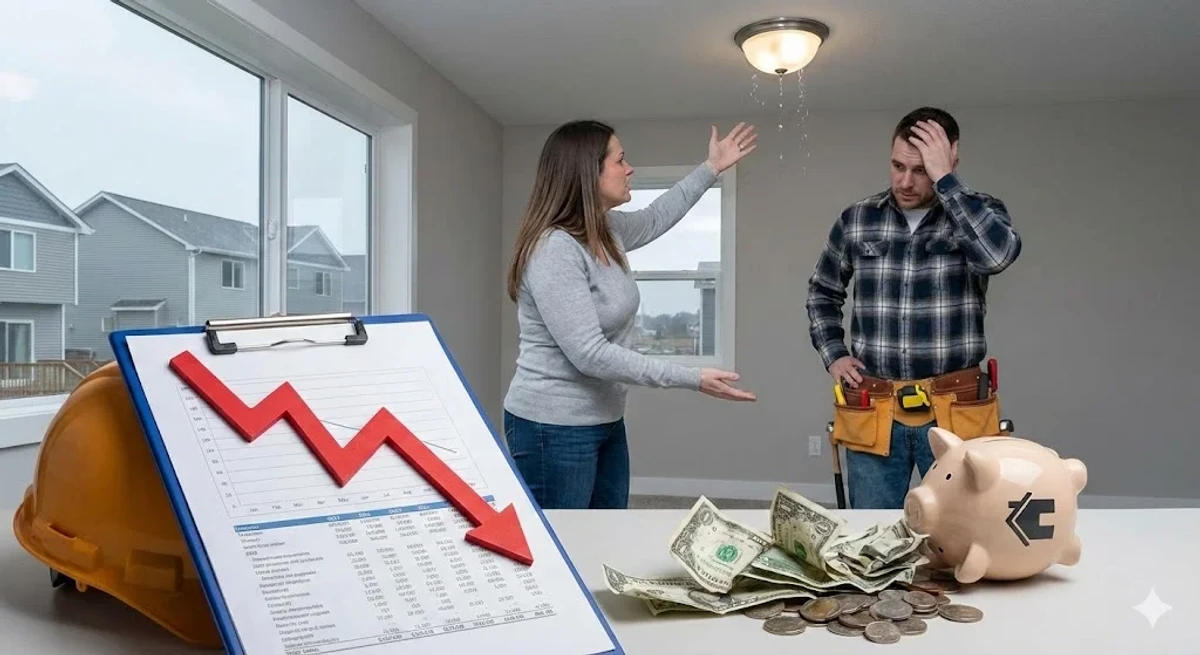
In the fast-paced world of homebuilding, it is tempting to celebrate the moment a house hits 100 percent completion. You have passed final inspections, the buyer has moved in, and your budget vs. actual looks solid. However, if you are simply closing the job WIP in your system and expensing trailing costs as they hit the P&L, you are not seeing your true profit. You are seeing a snapshot that is missing critical data points.
The reality is that a house is not financially finished just because the construction phase is over. When you fail to account for the work that happens and the bills that are not received until after the keys are handed over, you are fooling yourself into believing your margins are higher than they really are. This lack of accuracy has a direct negative impact on your ability to measure past performance to guide future projects.
The Problem: Post-Closing Margin Erosion
Many builders treat trailing costs and warranty expenses as general expenses that are recorded only when cash actually changes hands. Even worse, some leave these costs sitting in direct construction categories where their specific impact is completely hidden. This paints a misleading picture of your financial health.
The Closing Gap: Why Your Books Don't Match Reality
Inflated Margin Illusion: Your project margins appear stronger than they actually are because the tail of the project is missing from the final job cost. Without matching these trailing costs back to the specific home, you cannot see the specific percentage of margin being eroded by post close work.
Incomplete Job Costing: You cannot identify "warranty busts." While warranty expenses are a natural part of construction, a bust often reveals where a job was left 95 percent completed at close, forcing the remaining 5 percent of true construction costs to be treated as warranty.
Hidden Inefficiency: You lose the ability to accurately benchmark performance. If your data is skewed by uncaptured costs or warranty work buried in direct construction codes, you are making future pricing and estimating decisions based on a false baseline.
The CFO Solution: The Accrual and Variance Framework
To gain a detailed blueprint of your financial activities, you must move from cash basis thinking to an accrual based strategy.
Establish a Warranty Accrual: At the completion of every project, record an estimated warranty expense as a liability. This ensures the expense is matched against the revenue in the same period to provide a realistic view of project profitability.
Utilize Specific Variance Codes: At a minimum, use dedicated variance codes to track what is specifically warranty work. This allows you to differentiate between trailing construction costs and true warranty expenses. If you do not specifically track these, you have no way to measure the true costs associated with each project.
Regular Reconciliations: Offset actual spend against those accruals either monthly or quarterly. This keeps your balance sheet clean and alerts you to potential overbilling or budget holes before they become a trend.
Audit the Busts: When actual spend exceeds the estimate, treat it as a diagnostic tool. This process helps identify where a lack of completion at move in is driving up costs, or where duplicate billings and unusual trailing costs are slipping through the cracks unnoticed.
Reevaluate Accrual Rates: You must review your warranty accruals quarterly or annually to ensure the estimate is still accurate based on actual performance. As you focus on mitigating warranty spend and doing the job right the first time, these accrual amounts can come down. You just need the performance data to back it up.
The Business Impact: Real Data, Real Growth: Implementing this level of technical depth does more than just clean up your books. It changes how you scale.
When you track actual spend against estimates, you gain strategic visibility. You will know exactly which designs or vendors are costing you the most in the long run. Furthermore, banks and potential equity partners prefer the accrual method because it provides a more credible and useful view of a company's financial position. It proves you are not just building houses. You are managing a predictable, profitable business.
At HomebuildingCFO, we specialize in helping builders implement the financial frameworks and custom reporting necessary to capture every dollar of project cost. If you are ready to stop guessing at your margins and start building with financial precision, let's talk.